Legendary Trumpet Etudes PDFs — Free Books That Elevate Your Horn Practice

Legendary Trumpet Etudes PDFs — Free Books That Elevate Your Horn Practice
Can’t find trumpet etudes that actually level up your playing? Most free stuff online just collects dust—and barely helps your sound.
These seven trumpet etude books are what pro teachers, conservatory kids, and even famous conductors say are absolute must-haves. I spent years selling horns, chatting with legends at NAMM, and seeing students explode their skills with method books that work.
No need to stress about shady links or boring exercises. Want to make your trumpet sessions less of a slog and way more epic? You’re in the right place.
What Are Trumpet Etudes and Why Do They Matter?
Trumpet etudes are musical studies focused on specific technical skills (like tone or articulation) while staying musical and engaging. They’re not pure exercises. And they’re not performance pieces either. They bridge the gap between technique and actual music-making.
Etudes help you develop tone, articulation, range, flexibility, and sight-reading all at once. You’re training your brain to make musical choices while playing. As one of the most popular comments on Reddit says, etudes help you “make music and not just play them straight down”.
Professional trumpet players use etudes daily. Even pros warming up will run through etudes to keep their chops sharp and musicality alive.
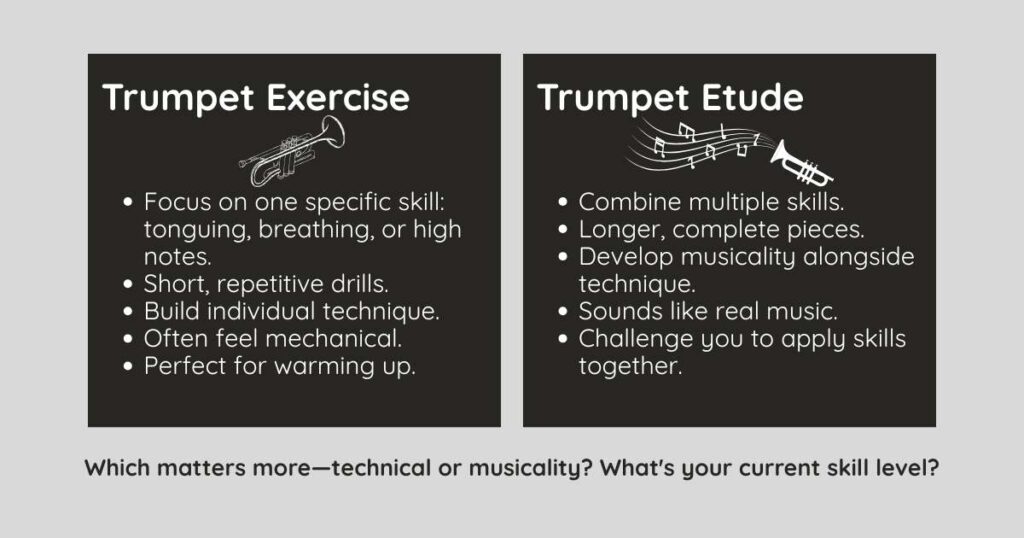
What’s the difference between etudes and exercises?
Exercises focus on one specific technical element. Clarke Technical Studies drill finger dexterity and speed. You’re drilling mechanics — fingerings, tonguing patterns.
Etudes combine technique with musical expression. You work on range or articulation while thinking about dynamics, phrasing, and style. Both matter in balanced practice. Exercises build fundamentals. Etudes teach you how to apply them musically.
How long should I spend on each etude?
It varies widely — one day to several months, depending on difficulty. Professionals spend one week on each advanced étude. Serious students spend two to three weeks.
Move on when you’ve achieved technical goals — not when it’s perfect. If you can hit the range notes cleanly, move on. If your articulation is crisp, you’re done. Don’t chase perfection for months. Playing different etudes keeps practice fresh.
1. Arban Complete Conservatory Method — The Trumpet Player’s Bible
Jean-Baptiste Arban was a French cornetist and conductor who changed trumpet playing forever (born in Lyon in 1825). He studied trumpet at the Paris Conservatoire in the early 1840s, and violin virtuoso Niccolò Paganini heavily influenced his playing style. Arban wanted to prove that the cornet and trumpet could be solo instruments — not just supporting players in orchestras.
In 1864, Arban published his “Grande méthode complète pour cornet à pistons” in Paris. That’s over 160 years ago, and trumpet etudes from this book are still used today. Musicians around the world call it the “Trumpet Bible” or simply “the Arban”.
Different editions exist today. The most popular modern version is the Goldman-Smith edition.
What’s Inside the Arban Method With Trumpet Etudes
The Complete Arban Method is massive (over 340 pages of trumpet etudes and exercises). It covers absolutely everything a trumpet player needs.
The book starts with First Studies, which focuses on tone production in the middle register. Then comes the slurring section, which has valve and lip slurs through the harmonic series. Check out these “5 Trumpet Long Tones PDFs Bundle“.
Next up are scales in every key — major, minor, chromatic, plus tons of variations. There’s extensive material on single, double, and triple tonguing. Arban includes sections on syncopation, dotted rhythms, triplet patterns, and 6/8 meter studies.
The book includes hundreds of exercises targeting specific skills (literally exercises for everything).
At the back, you’ll find the famous 14 Characteristic Studies — basically concert etudes that sound like real music. Arban also included his legendary arrangement of “Carnival of Venice” with crazy variations.
Who Should Use Arban and How
Arban is NOT for complete beginners. You need at least one to two years of playing experience before diving in. Teachers on Reddit and trumpet forums constantly remind people that “the Arban method was written for cornet students accepted into the Paris Conservatory who could already play really well!”
Trumpet legend Doc Severinsen once said that “everything you need is in the Arban and St. Jacome” and stressed there are no shortcuts — you have to practice hard. Working through the book systematically, NOT randomly jumping around.
Slow practice is essential. Playing at half tempo for a week will reveal issues and build solid technique. Practice 2x very slow and 1x very fast to build both accuracy and speed. Use a metronome to track your progress and increase tempo.
2. The Complete Ost Etudes — Modern Movie-Style Melodies for Contemporary Players
Nathan Ost — a contemporary composer and trumpet educator — created these etudes for young trumpeters. Unlike 19th-century books, Ost’s music employs a modern harmonic language similar to that of film scores. The Complete Ost Etudes brings together 84 total etudes across four collections.
Ost work is now a standard part of the curriculum at several universities across the United States. The International Trumpet Guild praised it as “destined for success,” which isn’t just nice words—it’s a big deal in the trumpet world.
What Makes Ost Etudes Unique
These etudes sound like movie soundtracks, not textbooks. The contemporary harmonic language makes each piece genuinely fun to play. You’re building trumpet technique through engaging melodies — NOT just grinding scales.
Ost’s trumpet etudes fit perfectly for middle school through early high school intermediate players. The difficulty progresses logically and keeps students engaged when classical etudes might bore them. Teachers report that students actually look forward to learning these pieces.
3. Charlier 36 Etudes Transcendantes — The Gold Standard for Advanced Players
Théo Charlier was a Belgian trumpet virtuoso who published his 36 Etudes Transcendantes in 1926. Based on his orchestral and teaching experience at the Royal Conservatory of Liège, he created exercises designed to push players beyond basic technique.
Why “transcendental”? Because they’re challenging concert pieces that demand everything from you — range, articulation, phrasing, endurance. The famous Charlier No. 2 (“Du Style”) is probably the most performed trumpet etude worldwide. These show up constantly for college auditions and All-State competitions.
Skill Level and Practice Approach
These trumpet etudes demand advanced chops. One Reddit user nailed it: “Charlier Etudes are not the only thing I play”. Each study takes weeks to months, depending on your level.
Work them in sections—don’t try perfecting everything at once. Some players spend months on the first two etudes before moving forward. Breaking them down and tackling them methodically beats rushing through them.
These etudes prepare you for real orchestral playing. Charlier actually based them on challenges he faced during his own orchestral career. One etude (No. 24) literally contains “trumpet passages from Wagner’s works”. You’re not just practicing—you’re learning the language of the orchestral trumpet repertoire.
4. Brandt 34 Orchestral Etudes — Musical Gems Based on Famous Repertoire
Vassily Brandt (1869-1923) founded the Russian trumpet school and shaped orchestral playing for over a century. Born in Germany as Karl Wilhelm Brandt, he moved to Moscow in 1890 and became principal trumpet at the Bolshoi Theatre. In 1900, he joined the Moscow Conservatory as the second trumpet professor.
Brandt’s story matters because he lived the orchestral life himself. He understood what trumpeters need to succeed in real performances. His 34 Orchestral Etudes are based on famous repertoire (like Beethoven, Tchaikovsky, and Rimsky-Korsakov). This practical experience shaped everything he taught.
What’s Inside the Brandt Studies
The collection has 34 etudes based on orchestral motives. Nearly every etude is a musical gem—not just boring exercises. Difficulty ranges from medium to hard, and they focus on orchestral style and phrasing.
Teachers use Brandt with serious college-bound students. Break each etude into sections for focused practice. Work slowly on rhythm and subdivision first, then add speed. Expect 2-3 weeks per etude if you’re intermediate to advanced.
The Brandt studies book is “really something special,” according to Reddit teachers. Students and professionals use these trumpet etudes throughout their careers. Middle school students tackle them as their first “hard” etude book. Professional musicians include them in daily warm-ups because the musical quality keeps them interesting.
5. Rubank Advanced Method Vol. 1 — The Gold Standard for Progressive Learning
The Rubank method is the foundation for generations of musicians.
Rubank Advanced Vol. 1 follows the elementary and intermediate books. Each book builds naturally on what came before. Teachers trust it because it actually works.
What’s Inside Rubank Advanced Vol. 1
You get serious material designed to level up your skills. The course covers scales and arpeggios in all major and minor keys. You’ll work through melodic interpretation, articulation studies, solo preparation, and flexibility exercises.
The 1 volume includes 10+ duets and contest-level solos. These aren’t simplified versions — they’re the real deal.
Rubank works beautifully with other methods (Arban, Schlossberg). Mix methods for well-rounded training. Find more “5 Must-Have Trumpet Warm Ups PDF — Proven Daily Routines“.
6. Bousquet 36 Celebrated Studies — Overlooked Lower Register Development
Narcisse Bousquet was a 19th-century French composer who originally wrote these studies for the flageolet (a small woodwind). Published around 1851, they were adapted for cornet and trumpet.
Bousquet himself said these studies provide “excellent practice for the lower register of the trumpet, which is often overlooked”. Most trumpet etudes chase high notes. Bousquet goes low instead.
Playing the lower register relaxes your lips between high-range work. Each study develops finger dexterity across different articulations and keys. This builds an even sound across all registers—think of it as foundation building before tackling Arban.
Skill Level and Progression
These 36 studies range from intermediate to advanced. They work for grade 9 players and beyond, covering every key. Early etudes suit strong high schoolers, while difficulty increases later. Reddit users recommend starting with the early sections.
Use Bousquet daily between high-range work to develop an even sound and relax your embouchure. Play one study, then return to upper register work. This approach builds finger facility without embouchure fatigue.
7. Goldman Practical Studies — Building Chops and Musicianship
Edwin Franko Goldman was America’s legendary bandmaster and trumpet pedagogue. He wrote Practical Studies in 1921, and it’s been proven effective for over 100 years. Goldman also edited other important trumpet books (like Bousquet’s 36 Celebrated Studies), cementing his legacy in brass teaching.
Goldman’s book tackles common issues all trumpet players face. What makes Goldman special is the practical, musical approach. These aren’t abstract exercises—they’re real-world situations you’ll encounter in orchestra or band.
Practice Applications
Goldman integrates smoothly into daily practice routines. Use it diagnostically to fix specific weaknesses — staccato tonguing, articulation, and flexibility. Pair it with Clarke and Arban for complete technical development.
Start slowly and build speed gradually while keeping articulation clean and tone solid.
Conclusion – Best Trumpet Etudes
These seven etude books work because professionals worldwide use them (proven through decades, not hype). They build your skills systematically—each exercise develops tonguing, range, flexibility, and phrasing.
Start with exercises matching your level. Work methodically. Track weekly progress. Patience beats talent every time. Consistency matters more than long weekend sessions. Practice for 10 minutes daily — NOT 3 hours once a week. Use a metronome. Record yourself and listen back.
Download the PDFs today. Pick one matching where you are now. Commit to daily practice. Join the trumpet community. Your transformation starts the next time you pick up your horn.