5 Must-Have Trumpet Warm Ups PDF — Proven Daily Routines And Start Practice Plan

Most trumpet players who do not practice trumpet warm ups (like 80% of us, honestly) fight with tone that’s all over the place and lips that tap out too soon. If you’re that person who sounds epic one day, weak sauce the next, you’re not alone.
But we got lucky—we have five legendary trumpet warm ups PDFs: Stamp, Schlossberg, Cichowicz, Wing, and Colin. (Seriously, trumpet world royalty right here.) These guys aren’t just names in old books. Their warm-up plans literally changed how to play.
Hit these trumpet warm ups daily for two weeks, and you’ll actually want to see your brass friends on weekends. Pick all five and you stop guessing what works — you get guaranteed results!
What Makes These 5 Trumpet Warm Ups PDFs Different From Random Exercises
Most trumpet players (especially newbies—and even a few old pros I’ve met) mix up what a warm-up, daily routine, and practice really mean. They’re not the same thing, and that’s a big reason why progress stalls.
- A warm-up (5–15 minutes) is just getting the blood flowing, waking up the lips, and syncing your mind with your airflow.
- A daily routine (20–60 minutes) builds and maintains fundamentals—sound, range, flexibility, articulation.
- Practice means time spent fixing weaknesses and polishing music (solos, band parts, that jazz chart you dread).
| Type | Duration | Purpose | Common Mistake |
|---|---|---|---|
| Warm-up | 5–15 min | Get lips and air moving | Playing too long or too high |
| Daily Routine | 20–60 min | Maintain/build fundamentals | Skipping for “real” practice |
| Practice | Varies | Work on music and weaknesses | Using it as more routine time |
A player on Trumpet Herald once said it best (I laughed but agreed): “You warm up so you don’t sound like you just rolled outta bed! You practice so you don’t sound like that forever.”
And yeah, this confusion isn’t new. Warm-ups should prepare you, not wear you out.
The Pedagogical DNA
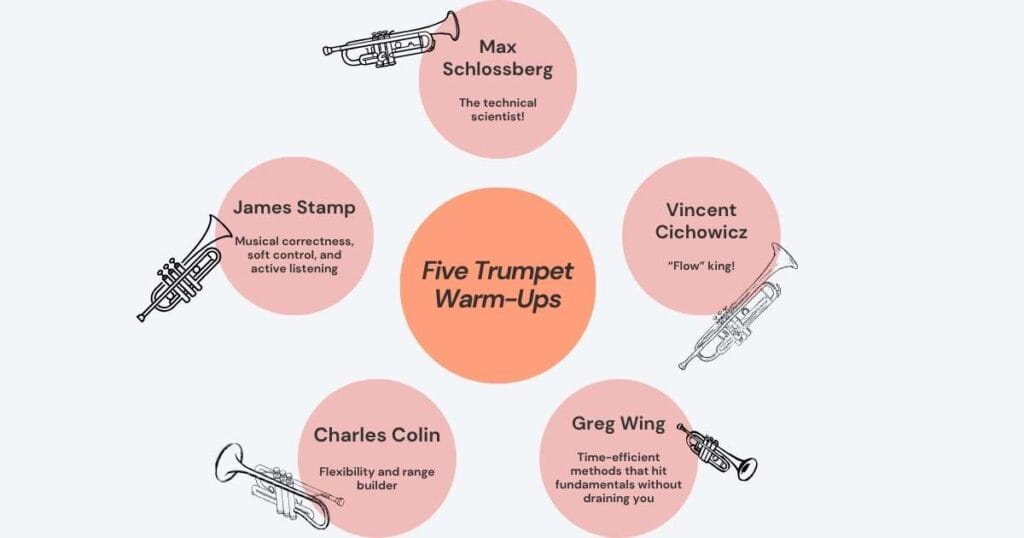
Each of the five trumpet warm ups focuses on one key principle that keeps your chops reliable (even on off days):
- James Stamp — Musical correctness, soft control, and active listening (he made us hear in tune, not just play).
- Max Schlossberg — The technical scientist: lip slurs, interval jumps, and tone consistency.
- Vincent Cichowicz — “Flow” king; his routines make your air move naturally, removing tension.
- Greg Wing System — Time-efficient methods that hit fundamentals without draining you.
- Charles Colin — Flexibility and range builder (no muscle fatigue, just smart repetition).
These routines aren’t just notes—they’re your daily foundation. You warm up to feel human, run your routine to stay sharp, and practice to play music. That’s what proper trumpet warm ups are all about.
1. James Stamp Warm-Ups and Studies — The GOAT Of Trumpet Warm Ups!
First off, let me say: James Stamp’s Warm-Ups & Studies is the foundation for sound, airflow, and lip flexibility (which all trumpet warm ups should give you, but Stamp actually delivers).
- Goal: Build an even tone from day one. Every page hammers in the message: keep it musical, not mechanical. (Can’t say that enough!)
You learn to center pitch, lock in airflow, and shape your ear—NOT just your chops.
What’s Inside the PDF
- Page 2: Breathing basics — no tension, balloons out, chest open up
- Page 3: Lip & mouthpiece buzzing. Buzz quietly, find the pitch. Don’t squeeze!
- Page 5: Ex.3 is the main event—sort of the daily “reset.”
- Pages 6–8: Exercise 4a, 4b, 5, 6—each gets a little trickier (play only what feels solid)
- Pages 19–23: Slurs, trills, bends, octaves. Don’t just play, listen to the center.
Stamp’s Methodology and Philosophy
Stamp’s method follows the mantra, “If it sounds correct, you’re doing it correctly.” He wanted students to hear the right sound before making it themselves, playing piano exercises while students buzzed or played along.
Do NOT skip the mouthpiece buzzing, or you’ll miss out on ear training and pitch centering that’s baked into the whole method.
The exercises progress from breathing (page two), to buzzing setup (page three), then the classic stamp trumpet warm ups (page five), and on to slurs and bends, trills and octave work in later pages. This musical approach — shaped by Max Schlossberg’s teaching lineage — is more about artistry, less about mechanics.
Many users try to skip straight to playing the trumpet without buzzing. That’s a major error and leads to missing the whole point of pitch development.
How to use Stamp in 10 minutes
Start with mid-register long tones, keep your volume at medium (mezzo piano), and let your notes glide smoothly from one to the next. It’s really about air moving steadily. The lips stay chill, not pinching or working overtime.
Get more “5 Trumpet Tone Exercises PDF — Free Sheet Music“!
If you’ve got a keyboard handy or a drone app, dial in your pitch before you start. Go slow — set your metronome anywhere between 60 and 72 bpm for the best result, but don’t race ahead. Your goal is to achieve ease, not chase range, especially in trumpet warm ups.
When you buzz, do it at mezzo piano or softer, and use a keyboard or app to match your pitches — don’t let your lips bottom out on pedals.
People on Reddit keep saying a stable air column keeps your face together when moving down to pedal tones. If you get caught with spreading tone on bends while slurring down low, stop and reset before moving back up.
Now I’ll write the content for the Max Schlossberg section according to the content brief specifications.
2. Max Schlossberg Daily Drills — Technical Precision
Max Schlossberg earned the title “father of American trumpet playing” for good reason. The Daily Drills and Technical Studies book has dominated brass pedagogy for over 60 years (since its 1937 publication). Players worldwide still crack open this green book every single day because it works.
Schlossberg himself played with the New York Philharmonic for 26 years (under conductors like Gustav Mahler and Arturo Toscanini). He also taught legends like James Stamp, William Vacchiano, and Harry Glantz. That’s some serious trumpet family tree.
Reddit trumpet players call these drills the “trumpet bible”. One user said: “Schlossberg is what unlocked almost everything for me…one of the best ways to reinforce fundamental concepts and extend your ability”.
Selecting Your Schlossberg Routine: A Practical Guide
Schlossberg has 156 exercises. Nobody plays all 156 every day (unless you’ve got four spare hours and zero life). The smart move would be to build a rotating selection that hits every technical area without turning practice into punishment.
Pick 2-3 exercises from each section. Chris Gekker (trumpet professor and pro player) created three rotating routines labeled A, B, and C. Each routine pulls exercises from different Schlossberg sections (long tones, intervals, lip slurs, and tonguing). You play Routine A one day, Routine B the next, Routine C the third day, then cycle back. This keeps your fundamentals sharp without boring repetition.
Progressive difficulty matters. Start with exercises 1-37 (long tones) before jumping to 129-156 (the gnarly etudes). Some teachers suggest playing two long-tone exercises daily for a week, then rotating them. Same pattern for intervals (exercises 38-48), octave drills (49-58), and lip drills (59-69).
Rotate your exercises weekly or monthly, depending on skill level. Beginners might stick with the same 2-3 exercises per section for a whole week. Advanced players swap daily to keep things fresh. Either way, track which exercises you’ve covered so nothing gets neglected.
How to run a tight Schlossberg block
Pick one interval page and one slur page. Start simple—exercises #12 (ascending lip slurs), #13 (descending lip slurs), or #14 (octave patterns with dynamics).
Slow first pass at 60-66 bpm. Quarter note = 40 is even better if your chops can handle the long phrases. Slower tempos expose air leaks, timing problems, and sloppy valve changes.
Tongue-slur alternation on repeat two. Play each exercise slurred first. Then, tongue the same exercise (legato tongue, not hammered attacks). This builds coordination between your tongue and air stream.
Add dynamic swell hairpins to stabilize air. Many Schlossberg exercises include written dynamics (like mf > p). Follow them exactly. The crescendo/decrescendo markings force steady air pressure.
One teacher explained: “Start strong dynamic on first note, keep same dynamic on second note, decrescendo and let the top note pop out”.
Cap at a comfortable top note. Don’t extend exercises beyond the “seconds” you reached today. If your chops are tired, your top comfortable note might be F# instead of high C. That’s fine. Schlossberg works at any range.
Rest fully between lines. Rest equals the time you just played. Played 30 seconds? Rest 30 seconds. No exceptions.
3. Vincent Cichowicz — Flow Studies
Vincent Cichowicz Flow Studies (the famous “moving long tones”) are an effective trumpet warm ups tool for building smooth, consistent tone production. These exercises work by training continuous airflow across all registers while keeping your sound centered and even.
Reddit players mention Cichowicz more than any other trumpet warm ups (especially Cichowicz Set #5), and for good reason—they fix messy air flow and uneven sound faster than anything else.
How to Run Flow Set 1–3 in 8 Minutes
Start at tempo ♩ = 50-56 and play at pp–mp (soft dynamics). Never push volume during Flow Studies—these are about control, not power.
Think “sing through the horn” as you play. Your air should feel like one continuous breath that happens to have pitch changes in it.
The Practice Steps:
- Breathe only at written cadences (bar lines and phrase endings)
- Keep your throat open and plan your breaths ahead of time
- Use “doo” articulation only on the first note of each group (everything else stays completely slurred)
- Rest as long as you play (this is crucial—take the mouthpiece off your lips between exercises)
- End the set with the same ease you started
If notes start spreading or fuzzing, add a leadpipe buzz for 30–60 seconds first. Remove your tuning slide, buzz the leadpipe at a resonant pitch (around F on a Bb trumpet), and focus on getting a clear, reedy buzz before adding the full horn.
If your tone gets fuzzy during the Flow Studies, drop down one key and try again. Quality matters more than range—always step down a set if you’re pushing.
The Chromatic Descent Pattern:
Start each exercise on the written pitch, then descend chromatically by half steps (using all valve combinations: 0, 2, 1, 1-2, 2-3, 1-3, 123). This ensures you work through every register and fingering combination.
Advanced players can add slur-two tongue-two patterns after mastering the basic slurred version. But only add articulation when you can maintain the same flow and sound quality.
4. Greg Wing — 20-Minute Routine
Greg Wing’s 20-minute warm-up is the efficiency champion (and honestly, it’s perfect when life gets crazy). Wing — professor of Music/Trumpet at Morehead State University — built this routine around one simple truth: “The secret is to DO IT every day!”
This routine compresses all your fundamentals into a repeatable circuit (breath work, long tones, slurs, flow studies, and technical drills).
Wing’s philosophy is straightforward: take a big breath, blow through the horn, and think “beautiful full sound” the entire time.
A Clean 20-Minute Setup You Can Copy
Here’s the exact minute-by-minute breakdown (straight from Wing’s PDF):
| Time | Exercise | What to Track |
|---|---|---|
| 00:00–02:00 | Breath + leadpipe | Ease, relaxation, no tension |
| 02:00–06:00 | Long tones | Full sound, steady air column |
| 06:00–10:00 | Easy lip slurs | Resonance, smooth transitions |
| 10:00–14:00 | Flow studies | Musical phrasing, no pressure |
| 14:00–18:00 | Clarke or Schlossberg | Evenness, finger-tongue sync |
| 18:00–20:00 | Soft long tone cool-down | Control, beautiful release |
Wing’s golden rule: rest as long as you play (and take a slight pause between exercises).
Wing designed this for busy students, comeback players, and gigging pros who need daily maintenance without the time commitment (high schoolers juggling band and homework love this).
It’s not ideal for absolute beginners (you might need slower, more detailed instruction first) or advanced players needing specialized high-level chops work.
The 10-Minute Emergency Version: On insane days, play sections 1-3 only (breath, long tones, lip slurs). You still touched fundamentals and kept the streak alive.
5. Charles Colin — Advanced Lip Flexibilities
Charles Colin’s “Advanced Lip Flexibilities” (three volumes in one) has been building range and endurance since the 1980s — and it works. But here’s the thing: this ain’t beginner stuff!!
A lot of folks call these “tongue level exercises” instead of “lip flexibilities”. That’s because your tongue position changes the airspeed — and that’s what really shifts the pitch (not just squeezing your chops).
How to program Colin without wrecking chops
Pick one study and play it at “singing volume” (that’s pp–mp, not mf–f). Loud playing early in the session kills flexibility.
Use an “air crescendo” across slurs — meaning faster air (not more mouthpiece pressure). Let the air do the work, not your face.
Limit top notes to your honest ceiling (don’t force notes you can’t hit yet). If you muscle through, you’ll teach bad habits and hurt yourself.
Alternate “expanding intervals” days with “lip trill” days — don’t do everything every day. These exercises are demanding and need recovery time.
Stop at the first sign of stiffness. Colin’s book can only be carried out by advanced players because it’s very demanding.
Equipment and Setup for Maximum Effectiveness
Getting your trumpet warm ups dialed in means having the right tools around you. You don’t need fancy gear (or spend a fortune), but wise equipment choices make every practice session more productive.
The Metronome — Your Timing Best Friend
A metronome keeps your rhythm tight and honest. Start every warm-up exercise at 60 BPM (that’s the sweet spot for building control). Use it during long tones, lip slurs, and buzzing drills to develop steady timing habits.
Budget pick: online Google’s free metronome works great. Step up: grab a Korg TM-50 (runs about $40), which combines a tuner and metronome in one device.
Pitch Reference Tools for Buzzing Practice
Mouthpiece buzzing without pitch reference is like driving blindfolded. You need something to lock onto. A piano works best (gives you the flexibility to hit any pitch you need). Or download a tuner app with a drone function.
Posture and Breathing Setup Matters
Sit or stand tall with relaxed shoulders and feet flat on the floor. Your chest should stay open (not collapsed forward). Keep your music stand at eye level so you don’t have to hunch down.
Good posture = better airflow = stronger tone. It’s that simple. Learn more in “Trumpeter 5 First Steps: How to Hold a Trumpet Like a Pro!“
Recording Equipment for Self-Assessment
Recording yourself is a game-changer (even if you hate hearing your own playing at first). Use your smartphone or grab a basic USB mic. Position the mic 2-4 feet from your bell and angle it slightly off-center (not pointing straight into the bell).
Play back your warm-ups to catch problems you miss in real-time.
Conclusion — Best Trumpet Warm Ups
You’ve now got five powerful trumpet warm ups PDF routines (each targeting different aspects of your playing).
The Clarke Technical Studies build your foundation. Caruso’s exercises develop your tone and endurance. The Arban’s Method covers the technique comprehensively. Stamp’s routines focus on efficient practice. And the Schlossberg exercises strengthen your fundamentals.
You don’t need to master all five PDFs immediately — that’s overwhelming and counterproductive. Start with one routine that addresses your biggest challenge.
Download one PDF today. Open it tomorrow morning. Play through it. Then repeat. That’s how excellence happens.
What’s your biggest warm-up challenge right now? Which PDF will you try first? Share your experience.